Kalas!
Trevlig läsning och bilder även om man inte är i utförsbranschen :)
/Johan
Och här kommer lite ABP-mumbojumpo till Chrillepille :)
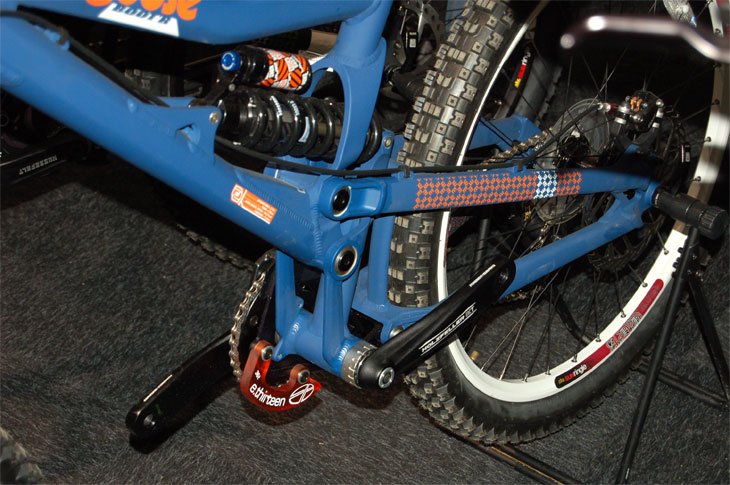
The active brake pivot puts the rear suspension pivot concentric to the rear wheel axle, as opposed to Trek’s current design or the ‘Horst’ link where the pivot is located above (Trek) or Below (Horst) the rear axel.
What is the Benefit?
-The ABP keeps the suspension active and the rider in control while braking. Lock-up, or stiffening of the suspension under braking is virtually eliminated. Skidding is reduced; the tire stays in contact with the ground. Because the tire stays in contact with the ground, the brakes are more effective when they are used, and thus the time spent braking is reduced. Less braking also equals better handling and suspension by not loading the front fork.
Less time braking = more time going fast!
-Wide stance pivot bearings – same as the main pivot. Because the rear pivot bearings are spaced wider apart, the frame structure is torsionally stiffer.
How does it work?
The ABP allows the suspension to be active and independent of braking by separating the braking and drive-train components. The ABP allows the brake caliper to keep a near constant relationship to the brake rotor, so the caliper doesn’t rotate around the brake disk as the suspension moves through its range of travel.
What’s the science behind ABP?
Abp_explaination_revkb Think that claim sounds too much like unsubstantiated marketing speak? Here’s the real deal, in-depth explanation (in other words, most of us will now tune out, and simply go riding and experience a ride like never before…)
The ABP allows the brake caliper to keep a near constant relationship to the brake rotor, so the caliper doesn’t rotate around the brake disk as the suspension moves through its range of travel.
Huh?
Brake force occurs between the ground and the tire. There is a contact patch on the bottom of the tire that is in contact with the ground. All modern, current suspension designs move the rear axel in an arcing motion. So when the brakes are applied, the wheel has to move in an arcing motion because it is fixed to the swing-arm. What this means is that the ground and the tire don’t exactly move together.
If you look at the bike with the suspension fully extended (bike completely un-weighted), there is a contact patch the tire has with the ground at 6 o’clock on the tire. With the wheel (and the tire) fixed to the swing-arm because of the brake being applied, when the suspension tries to move in the arc we described earlier, that original contact patch the tire had with ground moves.
However, because of friction between the tire and the ground, this contact patch doesn’t want to move. The rider feels this as “suspension stiffening” under braking, or a skidding, skipping feeling as the suspension bounces over bumps.
All suspension designs experience this to varying degrees, and all suspension designs can be analyzed to measure and quantify the amount of “contact patch rotation.” The lower or smaller the amount of rotation, the more active the suspension will be under braking.
ABP has the lowest rotation factor – lower than single pivot, lower than VPP, lower than FSR.
However, because the movement of the wheel is still based on our proven R1 design, all this active suspension comes without unwanted suspension movement. The bike is still highly efficient, bob-free, and without the need for suspension lock-outs.
Small bumps, big bumps, braking bumps, fast bumps – full time smooth, active, efficient suspension.
Here's how the Fuel EX compares to some of its competition. The first comparison is at the mid-stroke of the suspension, or at 50% travel. This is the most important measure because it's a bit past sag, and where the suspension is most likely to be during braking, and especially braking during high speed bumps.
Comparison of Contact Patch Rotational Factors – Mid-Stoke of Suspension Compression
2008 Fuel EX - 2.3 degrees
2007 Stumpjumper - 3.1 degrees
2007 Blur LT - 4.5 degrees
2007 Mojo - 4.0 degrees
Remember again, the lower the rotational number, the more active the suspension under braking.
Comparison of Contact Patch Rotational Factors – Full Suspension Compression
2008 Fuel EX - 6.0 degrees
2007 Stumpjumper - 7.3 degrees
2007 Blur LT - 6.3 degrees
2007 Mojo - 9.3 degrees