I går gjorde jag ett ramptest i mitt Adaptive-program. Efter att ha "misslyckats" med de två senaste testerna var jag peppad att ge gärnet. Misslyckandena var i att det första ökade jag FTP minimalt, och nummer två MINSKADE FTP, trots att jag egentligen tycker att jag blivit starkare än så. Dock så vet jag varför det blev så, jag var helt enkelt för trött av olika anledningar vid de tillfällena.
Nåväl testet i går gick lysande. Jag ökade FTP från 222 till 248 W (3,36 -> 3,75 W/kg). Det kändes mer som det skulle än de tidigare testen. MEN progression levels sattes tillbaka till 1.0 från att ha legat runt 5.
Före:
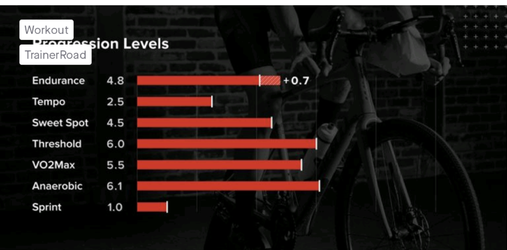
Efter:

Sen föreslog TR adaptations med sänkningar av kommande pass. På frågan om jag ville acceptera svarade jag nej.
Sen googlade jag lite, och då står det att när man ökar FTP "kraftigt" så resettas progression för att ökningarna annars kan bli för jobbiga.
Dock funderar jag på vad som nu händer när jag har ökat FTP, sänkt progression med nekat adaptations...
Vi får väl se

jag har ett VO2 Max på progression 5.1/TSS 71/IF 0,84 planerat i kväll.
Also had them mostly go back to 1 after a 5% FTP increase after a ramp test. This definitely needs some work, as this change was far too severe relative to the FTP change. I will be manually adjusting the next few workouts to be harder to get my progressions to a more reasonable place. For...

www.trainerroad.com
"Progression Levels automatically adjust after an FTP increase. I can’t explain the exact workings here, but the Levels preserve their relative relationship with each other and are adjusted to account for a rise in your capabilities. In your case, it was a large FTP increase of 3% (nice one!), so it’s normal to see the Levels adjust quite a bit.
We do this because the bump in your FTP can make any upcoming workouts feel harder than before if we kept them at the same Workout Level. That could lead to a situation where the first-week training at the new FTP was unproductive because the workouts were too difficult to complete successfully. This would then have negative consequences for the following weeks in that training phase.
By reducing the Progression Level, and in turn, upcoming Workout Levels, we can offset the FTP increase and serve you the right workouts for your current capabilities. This keeps the training on track and allows us to ramp the difficulty of workouts at a sustainable rate at your new FTP.
In any case, Progression Levels are dynamic, changing, real-time markers of progress, and as you continue to complete more workouts, you’ll begin to see them change fairly regularly. A higher progression level isn’t necessarily “better” or is even a sign of a stronger athlete; they simply reflect current capabilities at your current FTP. Your FTP is still the best indicator of fitness!"