En förklaring:
---
This standard frame design is referred to as a diamond frame. As you can see, each of these frames is comprised of two triangles sharing a common tube–the seat tube. The angle of the seat tube differentiates a Triathlon Bike from a Road Bike. The image above clearly shows the difference between a standard Road Bike, which typically has a 72°-73° seat tube angle, and a Triathlon Bike, which will have a seat tube angle of 76°-78°.
What effect does the seat tube angle have on a rider? Well, the steeper the seat tube angle, the more effort is exerted by the cyclists hamstrings compared to his or her quadriceps. That means a Road Bike allows you to use your bigger muscles (quadriceps) more and therefore you can exert more power relative to a Triathlon Bike. It also means, when you get off the bike, your quadriceps are more tired. No big deal if you are done for the day. Big deal if you still have to do some running.
To make up for the reduction in power that a steeper seat tube creates, a Triathlon Bike will typically have one or both of the following compensating features: aerobars and smaller wheels.
---
fortsättning, hjulen:
---
As for wheel size, there was a time when many triathlon bikes came with 650c wheels. These wheels are smaller than standard 700c wheels and supposedly offer faster acceleration, greater climbing ability, and a reduced profile (smaller wheels = less wind resistance). Technically, these benefits are all true. However, as a matter of practicality, there are very few instances in which the benefits of 650c wheels outweigh the drawbacks.
---


 Säljes i Jönköping
 Säljes i Göteborg
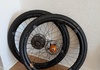 Säljes i Skåne
 Säljes i Skåne
 Säljes i Skaraborg