[RR] Tur du Mont Blanc på MTB
För 2 veckor sedan cyklade jag och min sambo (muffinsklubben på happymtb) vandringsruten Tour du Mont Blanc på 5 dagar genom Frankrike, Schweiz och Italien. Den här turen kan absolut rekommenderas. Man får träna sina lungor och utförskåkning allt på samma gång. Rapporten är på engelska (för att jag är för lat att skriva den på svenska).
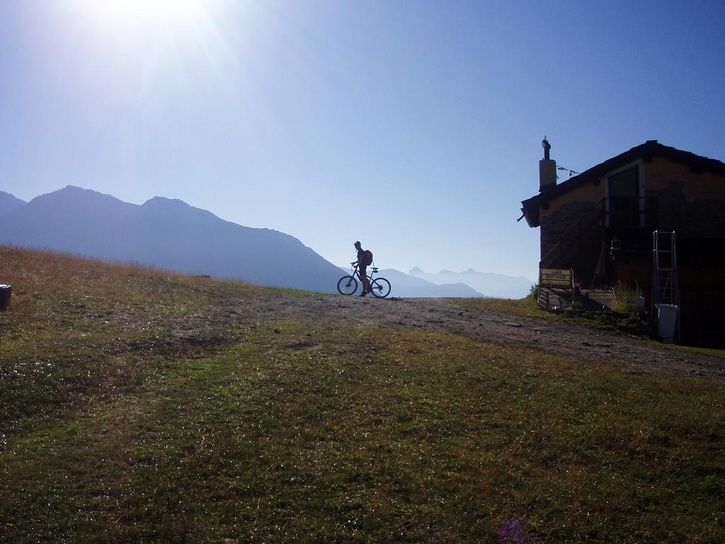
Three countries, 150 km of singletrack and gravel road, 6500 vertical metres and 5 alpine passes in 5 days - cycling a mountainbike around the Tour du Mont Blanc (TMB) was going to be an exciting but challenging prospect! After a lot of planning, lots of bike tuning, (and a lot less training), we arrived in Chamonix. Our minimalist backpacks were packed, and we were all ready for a 7am start the next day. “Crunch!”, said the bike. “Jävlar!”, said Oskar. At 8pm the night before leaving, he discovered that his front cogs were worn. So, the early start got postponed, but after an early visit to the local bike store (luckily Chamonix is full of them!), he had it fixed and we were ready to roll….
Day 1: Chamonix (France) to Col de La Forclaz (Switzerland), via Argentiere, Le tour, and Col de la Balme.
After finding a nice, shady, and hopefully safe place to park our car (which was full to the seams with camping and climbing gear), we swung our bikes onto the valley trails linking Chamonix and Argentiere. It was cool and shady in the forest, but the rolling trails soon had our hearts pumping and temperatures rising. It would be great to come back and really enjoy these trails nice and fast someday. Ever aware that we should take it easy on the first day, we kept an easy pace and soon passed the village of Argentiere. Continuing by road, we soon reached the Le Tour ski station, where we decided to take the cable car to Col de Balme, again in an attempt to keep the first day easy. It was cool and windy at the top of the pass, but our first views over the Mont Blanc massif were amazing. We donned our wind jackets and rolled along to the start of our first amazing single-track descent, and this was what greeted us:
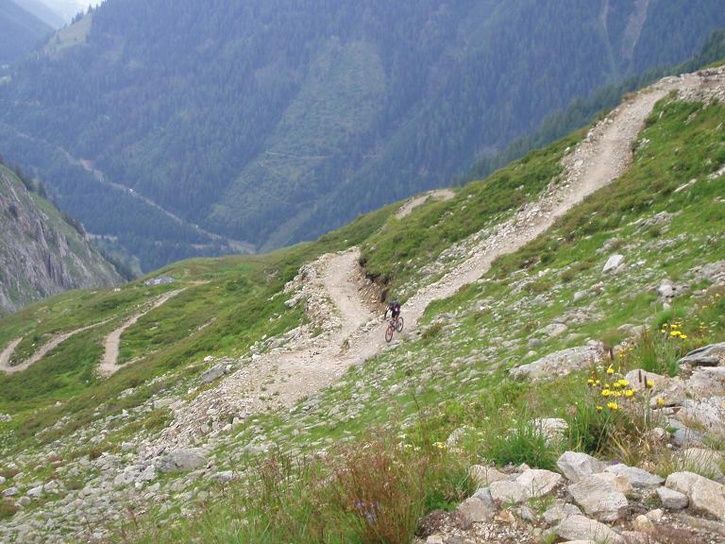
Almost 1000 vertical metres of rolling singletrack, technical switchbacks and steep terrain! The track continued all the way to the valley you can see in the photo with countless steep switchbacks through pine forest towards the bottom, whereby we changed into uphill mode for a 400 m climb to the Col de la Forclaz. The climb went way too quickly, (and easily we thought), and we were rather disappointed that a good first day ended so soon – we almost regretted taking the cable car! We settled into our first hotel dormitory for the trip, a rather grand, but old hotel, where we were very surprised to find out that they served three course dinners to smelly cyclists in the formal dining room! That night a storm swept over the pass with exciting displays of lightning, hail and wind. Unfortunately, we were later to learn that the same storm killed 3 female alpinists who froze to death on the other side of the massif.
Day 2: Col de La Forclaz (Switzerland) to La Fouly (Switzerland), via Bovine and Champex Lax.
Day 2 dawned cloudy and misty and the Col de la Forclaz, but we donned our lycra, heartily ate our breakfast and set off on a thin mountain path to the Bovine pass. Only a few hundred metres along, and we were already carrying our bikes uphill over steep rocky and rooty steps. Every now and again a small section was rideable, but we pretty much carried the bikes up 500 vertical metres.
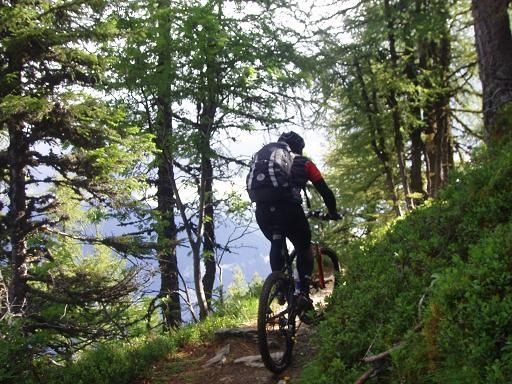
“Nevermind”, we thought, “there’ll certainly be a good descent as reward”. Hmmm. After some nice rolling singletrack descent above the treeline, we were met by a humming electric fence, and a whole field full of aggressive looking Swiss cows, each adorned with a bell the size of a small television around its neck. Tentatively, we opened the gate and snuck across the field followed by the stares of at least twenty curious bovine with large horns. Some of them were a bit frisky, and we hoped that they wouldn’t get attracted by our bar-ends, which bore a remarkable similarity to a pair of bulls horns!
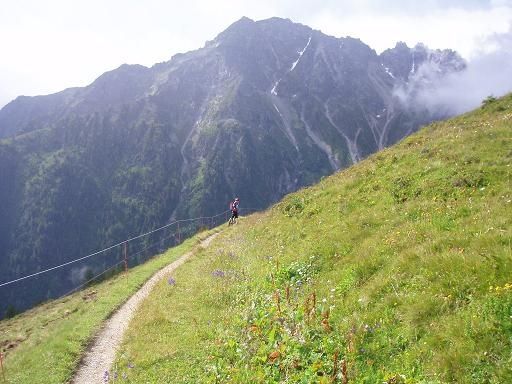
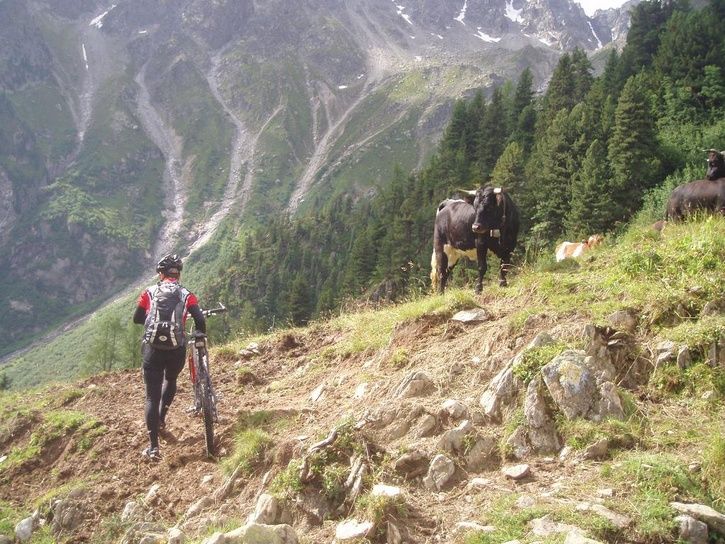
Safely across the field, we soon discovered why there was no need for a fence on the other side. For 700 vertical metres we lifted and carried our bikes down large roots and rocks, across roaring mountain rivers and past astonished hikers, who no doubt thought we were more than insane to have bikes in such a place.
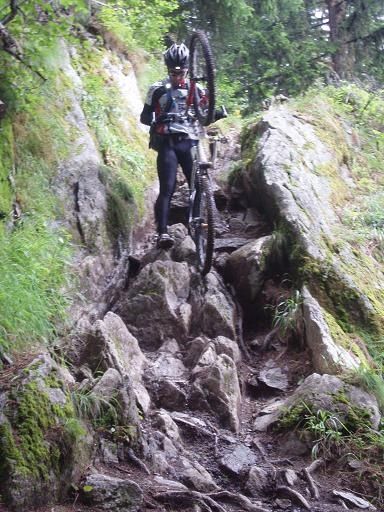
Eventually, the track widened into a road and we were finally able to straddle our frames and cycle downhill. In fact, the downhill seemed never-ending as we wound our way down the steepest roads we had ever seen (I think the gravel on these roads must roll down under its own weight!), but a downhill does have to end, and towards the end of the day, we took a right turn, pointed our bicycles up a new valley, and enjoyed a nice 400 vertical metres uphill on smooth bitumen roads to the Swiss mountain village of La Fouly. We checked into the evening’s abode and parked our bikes on the terrace before heading off to find a pre-dinner snack. Upon return, we found a mule laden with about 15 Ortlieb drypacks tied up immediately beside the bikes. I was a bit worried he might start chewing my saddle, so we hid the bikes behind the hotel, enjoyed a long, hot shower, dinner and bed.
Day 3: La Fouly (Switzerland) to Refugio de Monte Bianco (Val Veny, Italy), via the Col Ferret, Etreves and Val Veny.
This day was to start with a direct uphill to the Grand Col Ferret, at 25?? m, the highest pass of the trip. Luckily, we were able to warm up our tired legs on the good road up to the village of Ferret, famous for its local cheese farms. From here, a steep gravel road wound up the mountainside so we geared down to our easiest gears and started the long hard slog. Keep in mind that we live in a part of Sweden where the highest hills are 200 m above sea level, and you can imagine that we had somewhat feared such hills, but once we settled into a rhythm the cycling went remarkably well, and it took us less than an hour to conquer the first 500 m up. This was probably helped by the enthusiasm of a large group of French hikers who exclaimed “La Velo!!!” as I excused myself past, and “Allez, allez, allez” they shouted as an overenthused older French woman started running up the hill pushing my bottom to give me an extra push! “Merci, merci” was all I could manage as I spun the pedals uphill with a huge grin on my face!
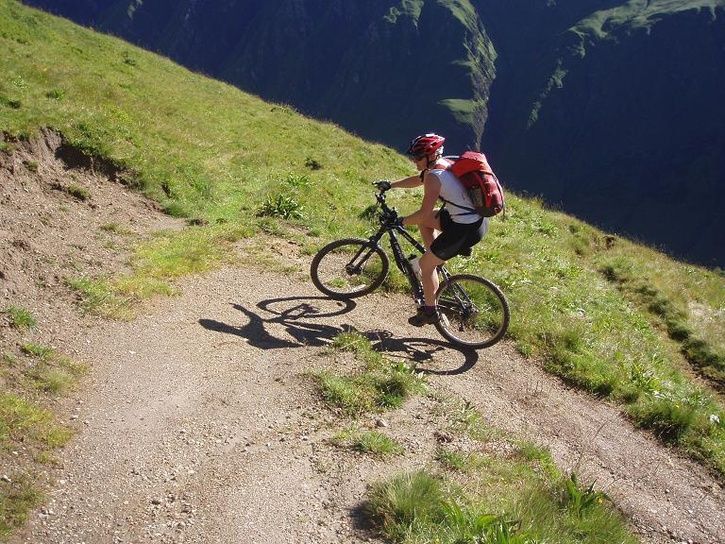
Eventually, though, the nice gravel road gave way to another rocky mountain path, although this one was at least rideable for a large part. We passed many groups of hikers who cheered us one and smiled as we passed. We also met more mules, picking their way down the paths decorated with their loads of bags, and followed by each team of hikers.
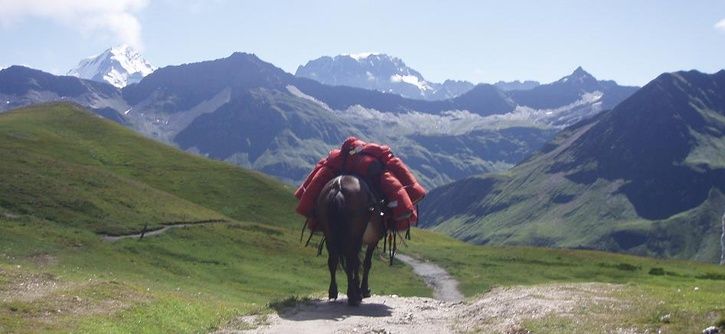
These mules left their own little surprises that one needed to pick one’s way around! As the trail progressed uphill, the views of snow capped peaks, rocky ridges, and tumbling glaciers became more and more amazing, and eventually the track reached its highest altitude on the border between Swizterland and France. We received a round of applause from those already at the top and an older Swiss gentleman pointed out to us the famous peaks and ridges we had read of in mountaineering books. He also pointed out the scantily clad (very, very, very short shorts) men and woman training for the Ultra-trail TMB, a competition where these highly trained runners manage to complete the entire trail in just 20 hours – unbelievable! We were to pass many of these types on our way around, and the thing they all had in common were long lanky legs!
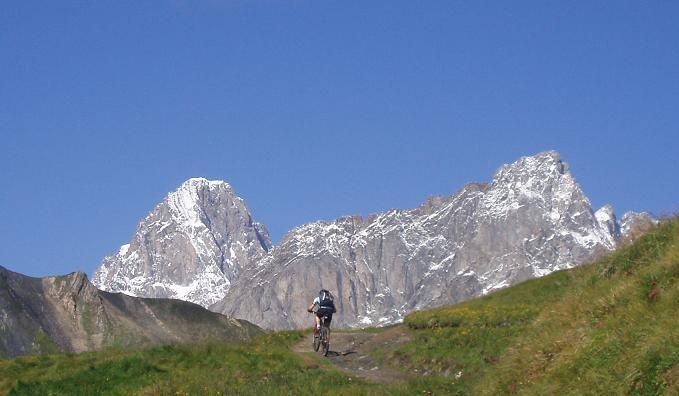
What goes up, must of course come down, and an exciting, but steep downhill followed. Unfortunately there were many large groups on their way up to the pass (most people hike the TMB in the opposite direction to our cycling), and we weren’t able to cycle all parts, but Oskar did manage a funny fall in front of a cheering group of Italian teenagers when he didn’t manage to click out of his pedals! He was quick to bow though!
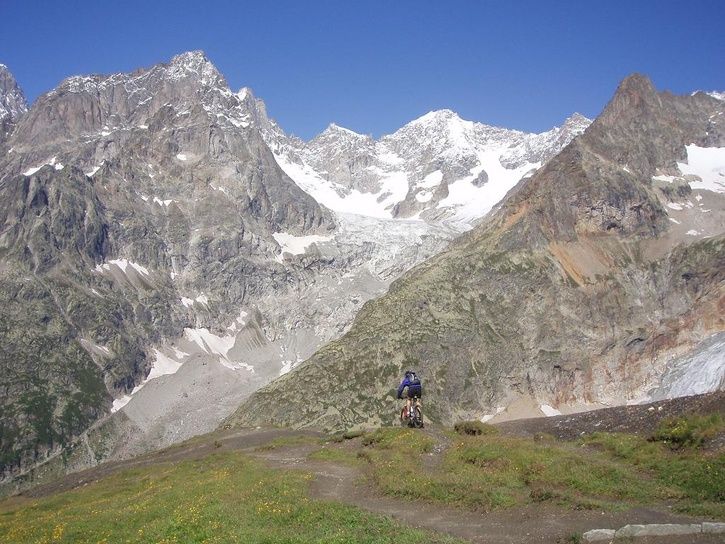
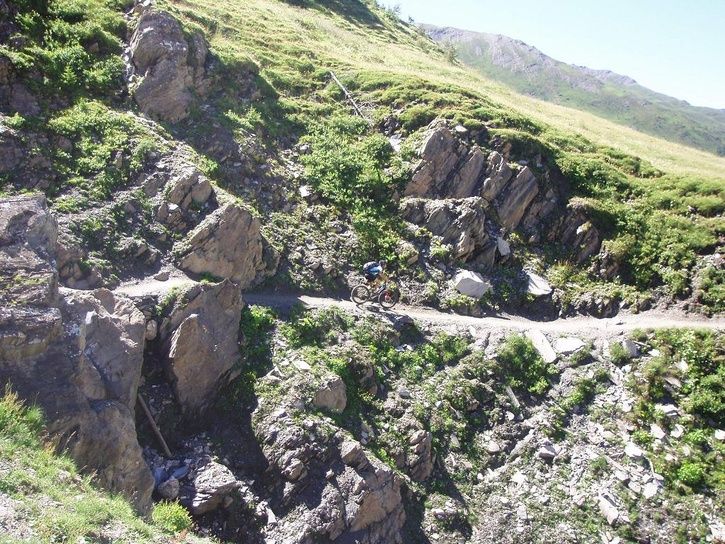
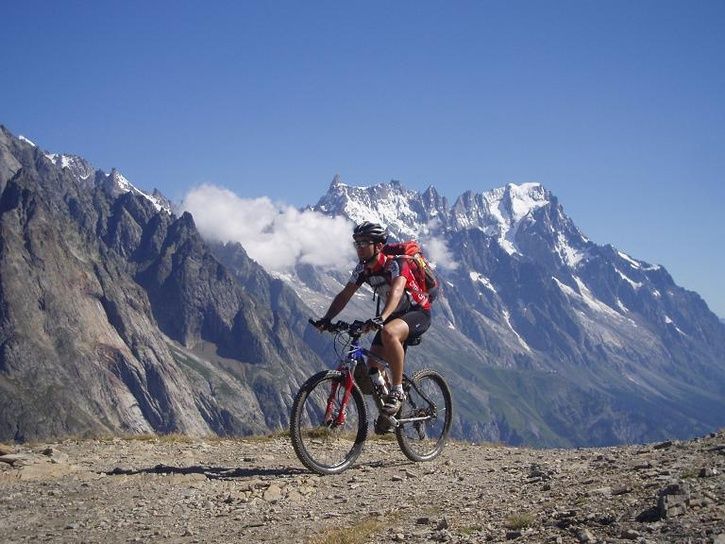
The track ended and a road started in the charming Val Ferret, where all of Italy seemed to be out sunning and fishing along the delightfully clear stream that carved out the valley. Along this road, it was a quick descent towards Courmayeur, but after finally finding some lunch in Entreves, we just bypassed Courmayeur, turning off past the Mont Blanc tunnel exit and starting a 400m climb up the Val Veny (Veny valley) where we had booked the next night’s hotel. This climb seemed much harder than on the previous days as the sun had emerged, hot and strong. We hopped from shade point to shade point along the steep uphill until we finally found the Refugio de Monte Bianco which we had booked for the night. From the terrace of this hotel we had fascinating views over the Italian side of the Mont Blanc massif. Our friend, Brad, who had been the trail in the opposite direction turned up so we all ordered beers and stared in wonder at the Peuterey ridge – a long and committing route to the top of Mont Blanc, at the Dent du Geant – a route we would like to have climbed the week after the cycling, and at the glaciers and their large moraines. Again we were treated to a three-course meal, this time Italian style with lashings of tortellini, followed by some meat, and ice-cream for dessert.
Day 4: Refugio de Monte Bianco (Val Veny, Italy) to Les Chapieux (France), via the Col de la Seigne.
I woke this morning to legs of lead. They just didn’t want to wake up. The evening before, Oskar and I had decided for this day to take the high path along the valley instead of the easier road taken by most cyclists. The day started with no chance of a warm up, instead a very steep push uphill in the forest beside a ski hill, and I wondered how I would ever get up the Col de La Seigne that day. The track emerged from the forest on the sides of a steep valley, again overlooking the Mont Blanc massif and as we progressed up the valley my legs started to lighten and the true summit of Mont Blanc emerged. In fact, this trail gave some of the best views of the trip and after the initial hard uphill, some great singletrack. The only downside to this detour was that we had to lose some of our hard-won altitude to regain the main path, but even this was well worth it with some of the best continuous rolling singletrack descent of the trip.
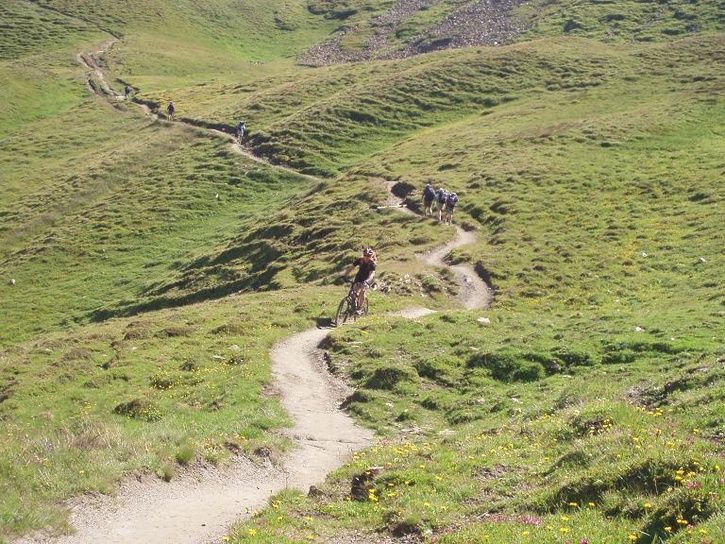
The valley was temporarily flat where we joined the original trail but soon enough a steep gravel-road climb to the Refugio de Elisabetta ensued. Again, we were pleasantly surprised at how well it went to cycle such roads – low gears and keeping a sufficiently low heart-rate seemed to work. Here, we met a group of cyclists with a guide who had taken the lower valley road. After lunch at the Refuge, we continued uphill on rocky hiking paths, past patches of snow, and lots of groups of hikers (who always seemed to congregate near the tops of the passes). The trail got steeper and our periods of pushing instead of riding increased, but we managed to remount the bikes for a triumphant pedal to the top of the pass. No cheers this time, but we lounged about on the top enjoying the perfectly sunny, windfree day (along with about a hundred other people, and four donkeys).
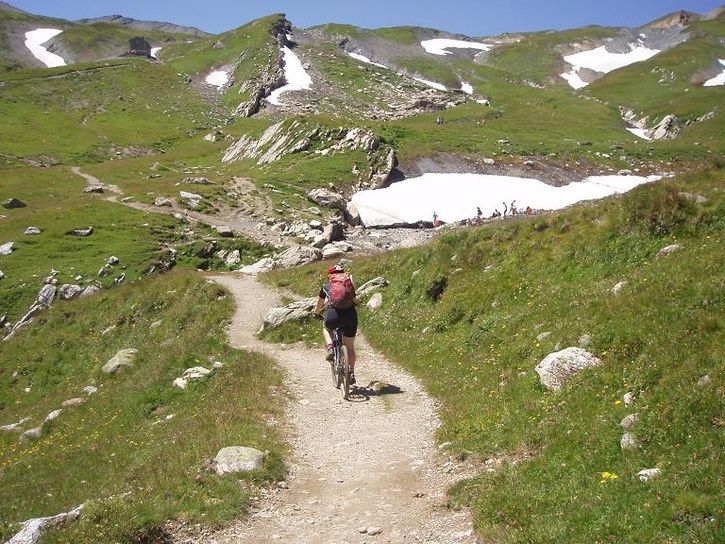
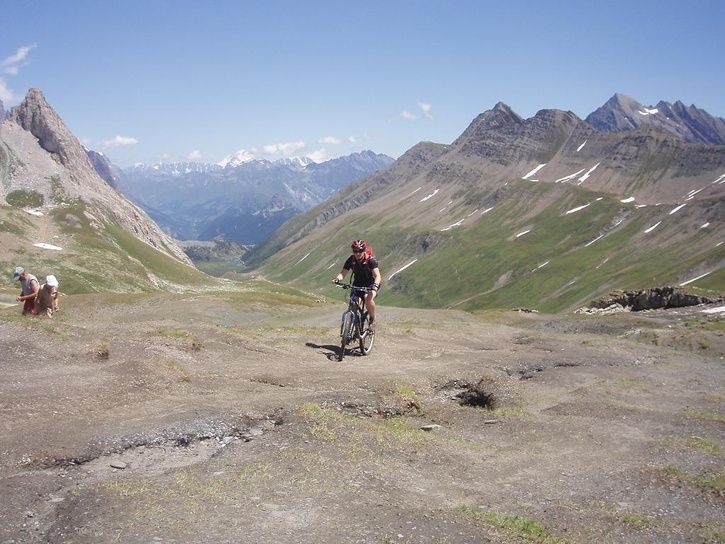
Soon though, we were enthused to begin the amazing looking descent below. We bounced and rolled down the never-ending hill. Here, the hikers had made many trails, so picking the best line downhill was half the fun. Halfway down we stopped to rest, waste time, and photograph the other cyclists coming behind us. They continued quickly past as they had a further refuge to ride to than us that day. We had nothing more than the long downhill to fill up the rest of the day, so enjoyed ourselves lounging in the grass a while before continuing downhill. Our hotel for the night was in the sleepy little village of Les Chapieux. This was a great place to stay. The village was charming and the hotel had a beautiful courtyard for relaxing over a beer. Having accustomed ourselves to three course meals, we were truly astounded when our third course of local cheeses was followed by a gigantic serving of blueberry cheesecake!
Day 5: Les Chapieux (France) to Chamonix (France), via Col de Croix de Bonhomme, Col de la Bonhomme, Les Contamines/Montjoie, Les Gervais and train back to Chamonix.
Four courses and a good night’s sleep must have done the trick, because we awoke feeling relatively refreshed. We had somewhat been dreading the day’s pass, as many cyclists and climbers had warned us that it was not rideable, but this was the quickest way back and we were committed. Surprisingly the first 300 m up went fast – some more of that easily rideable gravel road that we had become accustomed too. But, eventually that ended and a 700 m push and carry ensued. Indeed, we both felt that our arms were well trained by the end of the uphill. At the top we pulled out a local piece of cheese we had bought in Les Chapieux and having forgot to bring a knife, ate it like an apple, enjoying every last crumb.
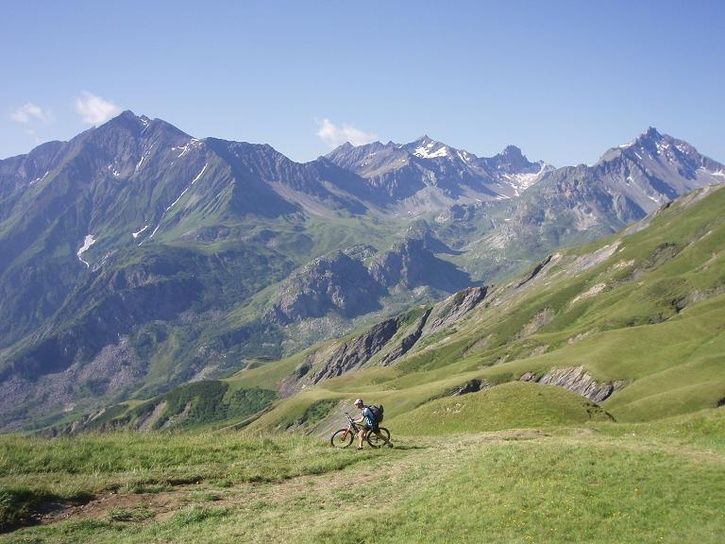
On the other side of the higher Col de la Croix de Bonhomme, things didn’t look that much better for cycling until we had reached the Col de la Bonhomme, from which the trail, though steep and serious, was mostly rideable (although we were attacked with questions by a string of curious Norwegian hikers who wanted to know everything about our bikes!).
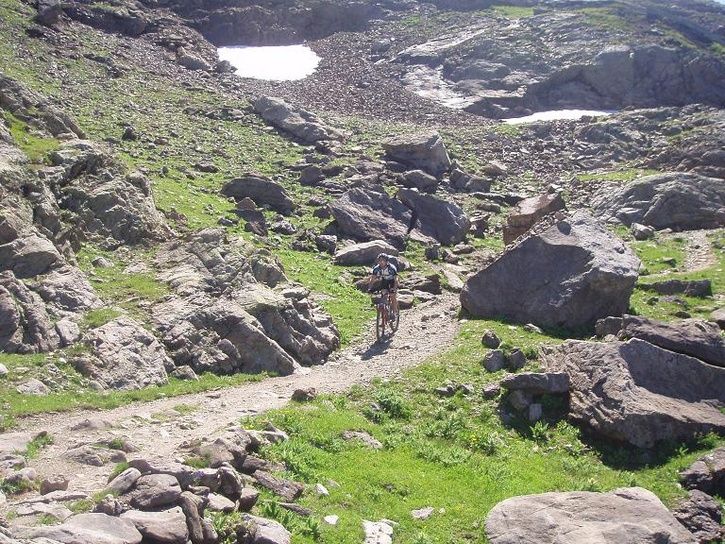
At one point we had to cross a large patch of snow where our wobbly attempts to ride were treated with cheers by lots of spectators. Further down we were congratulated by many astonished hikers (who tried to imagine themselves cycling down I guess). I felt bad for Oskar, as many were always even more astonished to see a girl doing such things, and saved all their congratulations for me!
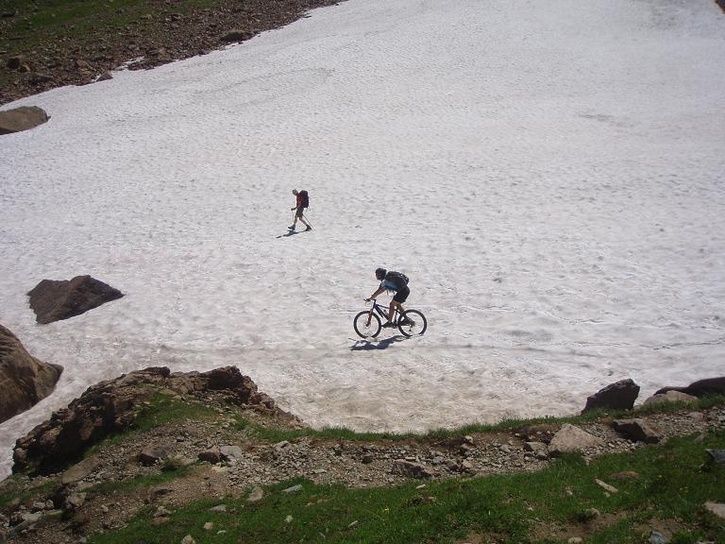
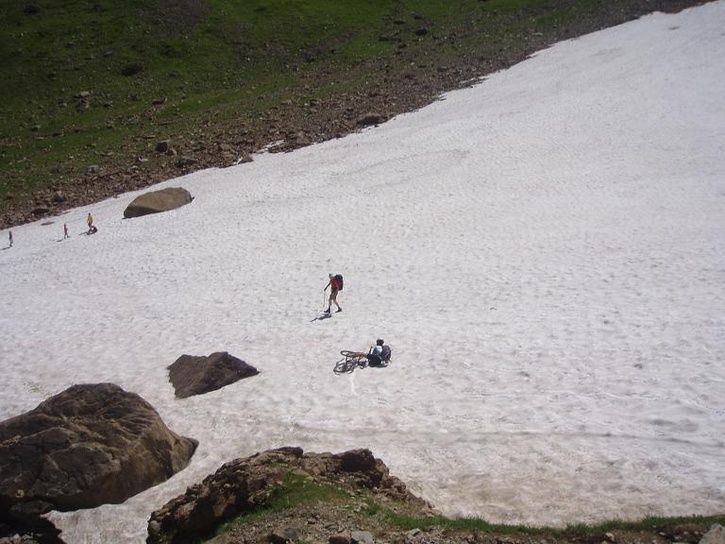
We stopped for lunch, a hearty omelette, at a hut on the way down, and then continued on steep loose gravel roads down, and down. About 400 m below the hut, we came to a lookout over a deep narrow gorge, where thundering water had dug its way long into the rock. Keen to take a photo, I looked around for the camera which was usually fastened to either Oskar’s or my handlebars. Gone! Had it shaken off on the way down!? Had I left it at the refuge at lunch? Luckily Oskar had some excess energy and he disappeared once again up the hill, asking everyone on the way if they’d seen a camera (or as he soon learned an ‘apparat de photographie’!) while I sat at the bottom stressing that we’d never find it. Eventually, a smiling waiter handed it over where we’d stopped for lunch and Oskar thundered back downhill where I sighed a breath of relief.
The track continued ever downwards over some steep granite slaps and finally onto a road. But this too continued downhill and via a coffee break in St Gervais, we dropped into the valley almost 2000 m below our starting point. Short of tackling another big alpine pass, our choices for getting back to Chamonix included waiting until 5:30 pm to take a mountain train to the top of the pass and taking downhill tracks to Chamonix (i.e. finishing really late), or taking the valley train back. We chose the latter option, satisfied after a great week’s cycling and eager to get back to showers, clean clothes, and a big fat pizza. This trip was definitely mountain biking at its very best!!!
Three countries, 150 km of singletrack and gravel road, 6500 vertical metres and 5 alpine passes in 5 days - cycling a mountainbike around the Tour du Mont Blanc (TMB) was going to be an exciting but challenging prospect! After a lot of planning, lots of bike tuning, (and a lot less training), we arrived in Chamonix. Our minimalist backpacks were packed, and we were all ready for a 7am start the next day. “Crunch!”, said the bike. “Jävlar!”, said Oskar. At 8pm the night before leaving, he discovered that his front cogs were worn. So, the early start got postponed, but after an early visit to the local bike store (luckily Chamonix is full of them!), he had it fixed and we were ready to roll….
Day 1: Chamonix (France) to Col de La Forclaz (Switzerland), via Argentiere, Le tour, and Col de la Balme.
After finding a nice, shady, and hopefully safe place to park our car (which was full to the seams with camping and climbing gear), we swung our bikes onto the valley trails linking Chamonix and Argentiere. It was cool and shady in the forest, but the rolling trails soon had our hearts pumping and temperatures rising. It would be great to come back and really enjoy these trails nice and fast someday. Ever aware that we should take it easy on the first day, we kept an easy pace and soon passed the village of Argentiere. Continuing by road, we soon reached the Le Tour ski station, where we decided to take the cable car to Col de Balme, again in an attempt to keep the first day easy. It was cool and windy at the top of the pass, but our first views over the Mont Blanc massif were amazing. We donned our wind jackets and rolled along to the start of our first amazing single-track descent, and this was what greeted us:
Almost 1000 vertical metres of rolling singletrack, technical switchbacks and steep terrain! The track continued all the way to the valley you can see in the photo with countless steep switchbacks through pine forest towards the bottom, whereby we changed into uphill mode for a 400 m climb to the Col de la Forclaz. The climb went way too quickly, (and easily we thought), and we were rather disappointed that a good first day ended so soon – we almost regretted taking the cable car! We settled into our first hotel dormitory for the trip, a rather grand, but old hotel, where we were very surprised to find out that they served three course dinners to smelly cyclists in the formal dining room! That night a storm swept over the pass with exciting displays of lightning, hail and wind. Unfortunately, we were later to learn that the same storm killed 3 female alpinists who froze to death on the other side of the massif.
Day 2: Col de La Forclaz (Switzerland) to La Fouly (Switzerland), via Bovine and Champex Lax.
Day 2 dawned cloudy and misty and the Col de la Forclaz, but we donned our lycra, heartily ate our breakfast and set off on a thin mountain path to the Bovine pass. Only a few hundred metres along, and we were already carrying our bikes uphill over steep rocky and rooty steps. Every now and again a small section was rideable, but we pretty much carried the bikes up 500 vertical metres.
“Nevermind”, we thought, “there’ll certainly be a good descent as reward”. Hmmm. After some nice rolling singletrack descent above the treeline, we were met by a humming electric fence, and a whole field full of aggressive looking Swiss cows, each adorned with a bell the size of a small television around its neck. Tentatively, we opened the gate and snuck across the field followed by the stares of at least twenty curious bovine with large horns. Some of them were a bit frisky, and we hoped that they wouldn’t get attracted by our bar-ends, which bore a remarkable similarity to a pair of bulls horns!
Safely across the field, we soon discovered why there was no need for a fence on the other side. For 700 vertical metres we lifted and carried our bikes down large roots and rocks, across roaring mountain rivers and past astonished hikers, who no doubt thought we were more than insane to have bikes in such a place.
Eventually, the track widened into a road and we were finally able to straddle our frames and cycle downhill. In fact, the downhill seemed never-ending as we wound our way down the steepest roads we had ever seen (I think the gravel on these roads must roll down under its own weight!), but a downhill does have to end, and towards the end of the day, we took a right turn, pointed our bicycles up a new valley, and enjoyed a nice 400 vertical metres uphill on smooth bitumen roads to the Swiss mountain village of La Fouly. We checked into the evening’s abode and parked our bikes on the terrace before heading off to find a pre-dinner snack. Upon return, we found a mule laden with about 15 Ortlieb drypacks tied up immediately beside the bikes. I was a bit worried he might start chewing my saddle, so we hid the bikes behind the hotel, enjoyed a long, hot shower, dinner and bed.
Day 3: La Fouly (Switzerland) to Refugio de Monte Bianco (Val Veny, Italy), via the Col Ferret, Etreves and Val Veny.
This day was to start with a direct uphill to the Grand Col Ferret, at 25?? m, the highest pass of the trip. Luckily, we were able to warm up our tired legs on the good road up to the village of Ferret, famous for its local cheese farms. From here, a steep gravel road wound up the mountainside so we geared down to our easiest gears and started the long hard slog. Keep in mind that we live in a part of Sweden where the highest hills are 200 m above sea level, and you can imagine that we had somewhat feared such hills, but once we settled into a rhythm the cycling went remarkably well, and it took us less than an hour to conquer the first 500 m up. This was probably helped by the enthusiasm of a large group of French hikers who exclaimed “La Velo!!!” as I excused myself past, and “Allez, allez, allez” they shouted as an overenthused older French woman started running up the hill pushing my bottom to give me an extra push! “Merci, merci” was all I could manage as I spun the pedals uphill with a huge grin on my face!
Eventually, though, the nice gravel road gave way to another rocky mountain path, although this one was at least rideable for a large part. We passed many groups of hikers who cheered us one and smiled as we passed. We also met more mules, picking their way down the paths decorated with their loads of bags, and followed by each team of hikers.
These mules left their own little surprises that one needed to pick one’s way around! As the trail progressed uphill, the views of snow capped peaks, rocky ridges, and tumbling glaciers became more and more amazing, and eventually the track reached its highest altitude on the border between Swizterland and France. We received a round of applause from those already at the top and an older Swiss gentleman pointed out to us the famous peaks and ridges we had read of in mountaineering books. He also pointed out the scantily clad (very, very, very short shorts) men and woman training for the Ultra-trail TMB, a competition where these highly trained runners manage to complete the entire trail in just 20 hours – unbelievable! We were to pass many of these types on our way around, and the thing they all had in common were long lanky legs!
What goes up, must of course come down, and an exciting, but steep downhill followed. Unfortunately there were many large groups on their way up to the pass (most people hike the TMB in the opposite direction to our cycling), and we weren’t able to cycle all parts, but Oskar did manage a funny fall in front of a cheering group of Italian teenagers when he didn’t manage to click out of his pedals! He was quick to bow though!
The track ended and a road started in the charming Val Ferret, where all of Italy seemed to be out sunning and fishing along the delightfully clear stream that carved out the valley. Along this road, it was a quick descent towards Courmayeur, but after finally finding some lunch in Entreves, we just bypassed Courmayeur, turning off past the Mont Blanc tunnel exit and starting a 400m climb up the Val Veny (Veny valley) where we had booked the next night’s hotel. This climb seemed much harder than on the previous days as the sun had emerged, hot and strong. We hopped from shade point to shade point along the steep uphill until we finally found the Refugio de Monte Bianco which we had booked for the night. From the terrace of this hotel we had fascinating views over the Italian side of the Mont Blanc massif. Our friend, Brad, who had been the trail in the opposite direction turned up so we all ordered beers and stared in wonder at the Peuterey ridge – a long and committing route to the top of Mont Blanc, at the Dent du Geant – a route we would like to have climbed the week after the cycling, and at the glaciers and their large moraines. Again we were treated to a three-course meal, this time Italian style with lashings of tortellini, followed by some meat, and ice-cream for dessert.
Day 4: Refugio de Monte Bianco (Val Veny, Italy) to Les Chapieux (France), via the Col de la Seigne.
I woke this morning to legs of lead. They just didn’t want to wake up. The evening before, Oskar and I had decided for this day to take the high path along the valley instead of the easier road taken by most cyclists. The day started with no chance of a warm up, instead a very steep push uphill in the forest beside a ski hill, and I wondered how I would ever get up the Col de La Seigne that day. The track emerged from the forest on the sides of a steep valley, again overlooking the Mont Blanc massif and as we progressed up the valley my legs started to lighten and the true summit of Mont Blanc emerged. In fact, this trail gave some of the best views of the trip and after the initial hard uphill, some great singletrack. The only downside to this detour was that we had to lose some of our hard-won altitude to regain the main path, but even this was well worth it with some of the best continuous rolling singletrack descent of the trip.
The valley was temporarily flat where we joined the original trail but soon enough a steep gravel-road climb to the Refugio de Elisabetta ensued. Again, we were pleasantly surprised at how well it went to cycle such roads – low gears and keeping a sufficiently low heart-rate seemed to work. Here, we met a group of cyclists with a guide who had taken the lower valley road. After lunch at the Refuge, we continued uphill on rocky hiking paths, past patches of snow, and lots of groups of hikers (who always seemed to congregate near the tops of the passes). The trail got steeper and our periods of pushing instead of riding increased, but we managed to remount the bikes for a triumphant pedal to the top of the pass. No cheers this time, but we lounged about on the top enjoying the perfectly sunny, windfree day (along with about a hundred other people, and four donkeys).
Soon though, we were enthused to begin the amazing looking descent below. We bounced and rolled down the never-ending hill. Here, the hikers had made many trails, so picking the best line downhill was half the fun. Halfway down we stopped to rest, waste time, and photograph the other cyclists coming behind us. They continued quickly past as they had a further refuge to ride to than us that day. We had nothing more than the long downhill to fill up the rest of the day, so enjoyed ourselves lounging in the grass a while before continuing downhill. Our hotel for the night was in the sleepy little village of Les Chapieux. This was a great place to stay. The village was charming and the hotel had a beautiful courtyard for relaxing over a beer. Having accustomed ourselves to three course meals, we were truly astounded when our third course of local cheeses was followed by a gigantic serving of blueberry cheesecake!
Day 5: Les Chapieux (France) to Chamonix (France), via Col de Croix de Bonhomme, Col de la Bonhomme, Les Contamines/Montjoie, Les Gervais and train back to Chamonix.
Four courses and a good night’s sleep must have done the trick, because we awoke feeling relatively refreshed. We had somewhat been dreading the day’s pass, as many cyclists and climbers had warned us that it was not rideable, but this was the quickest way back and we were committed. Surprisingly the first 300 m up went fast – some more of that easily rideable gravel road that we had become accustomed too. But, eventually that ended and a 700 m push and carry ensued. Indeed, we both felt that our arms were well trained by the end of the uphill. At the top we pulled out a local piece of cheese we had bought in Les Chapieux and having forgot to bring a knife, ate it like an apple, enjoying every last crumb.
On the other side of the higher Col de la Croix de Bonhomme, things didn’t look that much better for cycling until we had reached the Col de la Bonhomme, from which the trail, though steep and serious, was mostly rideable (although we were attacked with questions by a string of curious Norwegian hikers who wanted to know everything about our bikes!).
At one point we had to cross a large patch of snow where our wobbly attempts to ride were treated with cheers by lots of spectators. Further down we were congratulated by many astonished hikers (who tried to imagine themselves cycling down I guess). I felt bad for Oskar, as many were always even more astonished to see a girl doing such things, and saved all their congratulations for me!
We stopped for lunch, a hearty omelette, at a hut on the way down, and then continued on steep loose gravel roads down, and down. About 400 m below the hut, we came to a lookout over a deep narrow gorge, where thundering water had dug its way long into the rock. Keen to take a photo, I looked around for the camera which was usually fastened to either Oskar’s or my handlebars. Gone! Had it shaken off on the way down!? Had I left it at the refuge at lunch? Luckily Oskar had some excess energy and he disappeared once again up the hill, asking everyone on the way if they’d seen a camera (or as he soon learned an ‘apparat de photographie’!) while I sat at the bottom stressing that we’d never find it. Eventually, a smiling waiter handed it over where we’d stopped for lunch and Oskar thundered back downhill where I sighed a breath of relief.
The track continued ever downwards over some steep granite slaps and finally onto a road. But this too continued downhill and via a coffee break in St Gervais, we dropped into the valley almost 2000 m below our starting point. Short of tackling another big alpine pass, our choices for getting back to Chamonix included waiting until 5:30 pm to take a mountain train to the top of the pass and taking downhill tracks to Chamonix (i.e. finishing really late), or taking the valley train back. We chose the latter option, satisfied after a great week’s cycling and eager to get back to showers, clean clothes, and a big fat pizza. This trip was definitely mountain biking at its very best!!!
Senast redigerad av en moderator: