Här är ett axplock av råd från däcktillverkarna själva samt resultat av opartiska studier som avhandlar slitage orsakat av för lågt däcktryck för de som tror att det tävlingseliten kör på under tävling alltid är det bästa i alla vardagliga situationer och för de som försummar slitaget orsakat av lågt däcktryck:
"The sidewalls of tires often fail before the tread is worn out. In most cases, this premature wear is due to prolonged use of the tire with insufficient pressure. Checking and re-pumping the inflation pressure at least once a month with a pressure gauge is most important." -
https://www.schwalbe.com/en/technol...O_j_ftvHheNDXCWEfug3g9WrQefSL7Za6CbaPcw4sR9nn
"Low air pressure won't necessarily ruin your ride, but if it's too low it can impact road handling and stability. In extreme cases it can lead to tire damage, tire wear, rim damage, or even punctures.
Bike tire maintenance: tire pressure
If the air pressure is too high, meanwhile, you may end up feeling every little bump and imperfection from the road. This could be too harsh for your comfort, especially for long rides in the saddle." -
https://www.continental-tires.com/stories/bike-tire-maintenance/
"Bike tires are designed to perform under specific conditions, and air pressure is a significant factor. Tire wear is influenced by various elements, including:
Load distribution
Contact patch
Heat buildup
Structural integrity
When a tire is under-inflated, it experiences increased stress and friction, leading to faster wear." ....
..."Under-inflated tires have a larger contact patch with the road, increasing friction. This extra friction generates more heat, causing the rubber to degrade faster.
According to the Rubber Manufacturers Association, under-inflated tires can reduce tire life by up to 25%.
Heat buildup is especially detrimental, as it accelerates the breakdown of tire materials, leading to premature wear and potential failure.
A tire with less air tends to wear unevenly. The outer edges of the tire bear more weight, while the center remains underutilized.
This uneven wear can cause the tire to lose its shape, making it perform worse and become less safe.
The National Highway Traffic Safety Administration (NHTSA) found that tires under-inflated by 20% can increase tire wear by up to 16%." -
https://teswaybike.com/blogs/news/bike-tire-wear-out-faster
Särskilt intressant ät den sista biten. Ett undertryck på 20% kan man tolka på flera sätt då tillverkare anger tryck på sidoväggarna helt olika. Vissa anger specifikt "Inflate to 5 bar" andra har "Recommended pressure 5 bar" Conti kör ofta bara med "Maximum pressure 4.5 bar" medan de flesta har ett spann: "Min 3,5 bar. Max 6 bar".
Oftast stämmer 20% regeln in på spannet där minimumtrycket ofta är i närheten av 20% av maxtrycket.
Det betyder att man kan tolka ett undertryck på 20% som antingen 20% av minimumtrycket, snittet i mitten eller ett för dig uträknat tryck via en däxktryckskalkylator. Även 20% av trycket som är 20% av maxtrycket kan användas som chablon.
Har man normal kroppsvikt och ligger 20% under minimumtrycket som är 3 bar kan man alltså lugnt säga att kraftigt, onödigt slitage på däxk/slang sker redan vid:
0,8 x 3 = 2,4 bar.
Vid däck med säg 8 bar maxtryck blir det alltså onödigt slitage redan vid:
(0,8 x 8) X 0,8 = 5,12 bar.
Väger man som jag, mer än snittet på 93 panner så skulle jag aldrig köra under 6 bar på ett däck med max 8 bar tryck för att hålla god ekonomi och pålitlighet när jag cyklar till jobbet. Hur kul det än är att skruva cykel så är oplanerade stopp sällan positivt.


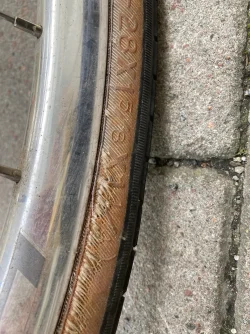

 ).
).