There are two concepts in tribology that are critical to understanding these chain lubrication issues. They are 1) surface tension, and 2) capillary tension.
To illustrate these ideas, imagine we have a classic ink pen, the kind you dip to flood a little capillary gap. We also have a chemical we use on surfaces to prevent oil creep that is called a barrier film. A barrier film is based on altering the surface tension so that the surface will not "wet". So imagine how water beads on a well waxed automobile paint job.
Now if you take that ink pen and treat the whole thing with the barrier film, if there were nothing else going on that treatment would not allow the ink to wet the surface of the pen. But an ink pen dipped in barrier film still works. In fact, even two Teflon surfaces at the correct gap, will hold fluid even though Teflon is not "wetable".
There is a saying in tribology that capillary gap trumps surface tension. This is important in the context of the video about waxing the chains.
If the barrier film cannot stop the ink pen from working, it is because the ink will still hold in that little capillary gap even though the surface tension is such that the surface does not want to wet.
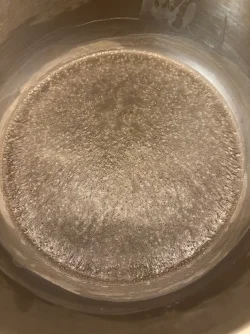
Now if we jump to chain waxing, the removal temperature does affect the viscosity and surface tension of the wax and contributes to the "drag-out" on the surfaces and corners, but has almost no effect on the internal capillary gaps. The capillary effect between the plates and inside the pins and rings, will still hold the same volume of wax.
The majority of the "important" wax in this context, is the wax in those capillary gaps, which are essentially identical as long as the wax is above the melt temperature and can flow into the gaps. So while the lower viscosity of the hotter temp withdrawal will certainly thin the layer on external flat surfaces and outside corners, it has almost no effect on the inside capillary gaps.


 Några tips på hur man bäst rengör? Trasa med såpa och vatten verkar vara en del här som kör?